
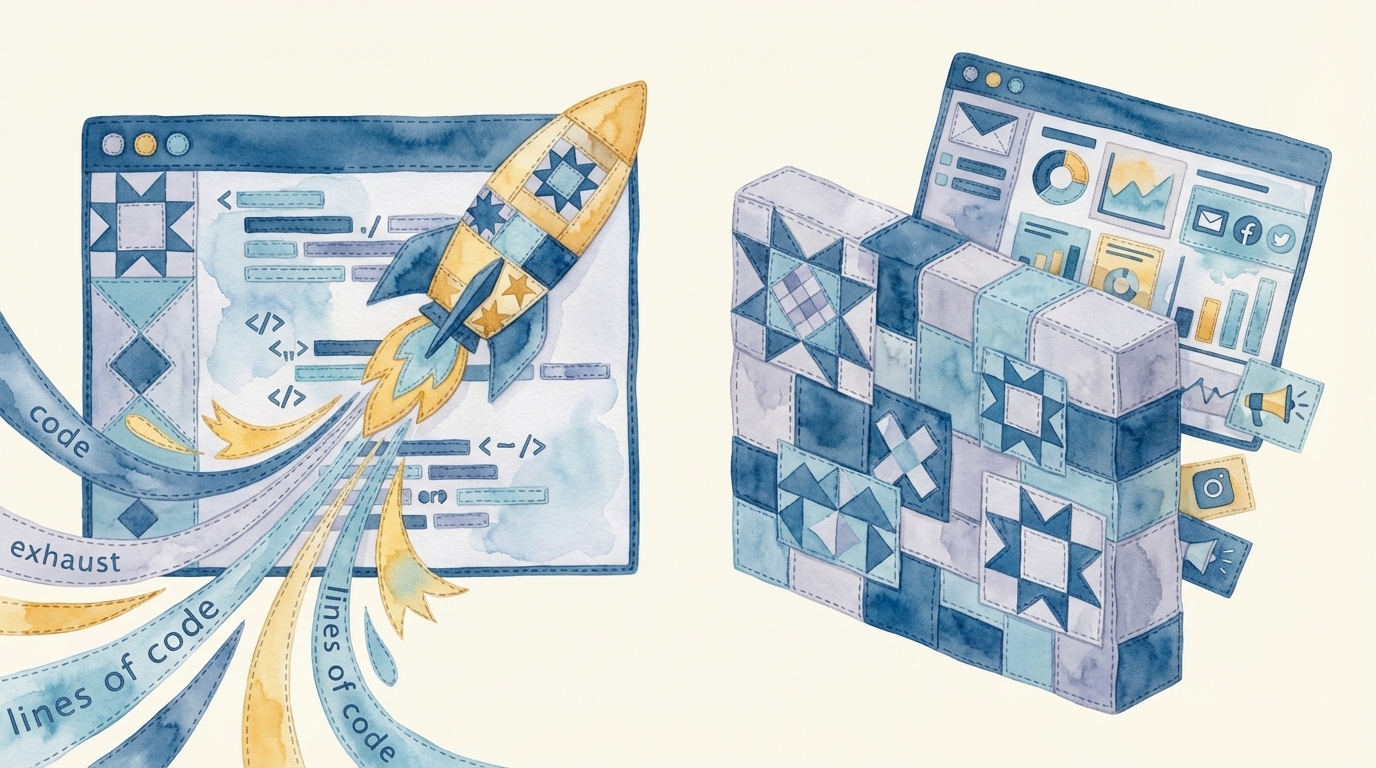
In San Francisco engineering offices, AI agents are shipping production code every day. Claude Code generates and commits backend services. Cursor autocompletes entire React components. OpenAI's Codex opens pull requests that pass CI and merge without human edits. According to recent surveys, 95% of developers now use AI coding tools on a weekly basis. These tools do not just suggest — they deploy. Code goes from prompt to production in minutes.
Meanwhile, marketing teams — who adopted generative AI for copy and images early — still cannot get an AI agent to deploy a single campaign. Not a draft. Not an asset in a folder. A live, deployed campaign running inside HubSpot, Marketo, or Salesforce Marketing Cloud. The question is simple: why can AI agents write and ship code, but not deploy marketing campaigns?
The answer comes down to three structural differences between software engineering and marketing operations. Understanding these gaps is the first step to closing them.
Gap 1: Code Has Tests, Marketing Doesn't
When an AI coding agent writes a function, it also writes a test. The test defines the expected behavior. CI runs the test. If it fails, the code does not merge. This feedback loop is what makes autonomous code deployment possible — the system can verify its own work before it reaches users.
Marketing has no equivalent. When an AI generates an email, there is no automated check that verifies the subject line is under 60 characters, the personalization tokens resolve correctly, the CTA links point to the right landing page, the suppression list is applied, or the send time aligns with the recipient's timezone. Each of these checks is performed manually by a human operator clicking through a marketing automation platform's UI.
"The last mile of AI deployment is not generation — it is verification. Until marketing has a test suite equivalent, AI will remain in assist-only mode." — adapted from Harvard Business Review's analysis of AI's last mile problem
This is not a trivial gap to close. Software testing is built on deterministic assertions: this function returns 42 when given inputs X and Y. Marketing verification requires judgment calls about brand tone, audience appropriateness, and strategic alignment. But the structural elements — valid links, correct merge fields, proper list segmentation — are absolutely testable. The industry just has not built the frameworks yet.
Gap 2: Code Repos Are Standardized, Marketing Stacks Are Bespoke
Every software project in the world uses git. The interface is universal: clone, branch, commit, push, merge. An AI agent trained on one codebase can operate on any codebase because the deployment surface is standardized.
Marketing stacks are the opposite. No two companies configure HubSpot the same way. Custom properties, naming conventions for lists and workflows, folder structures, template hierarchies, lifecycle stage definitions — all of it is bespoke. A marketing AI agent cannot assume anything about the environment it is deploying into.
This is why 80.6% of marketing AI usage remains in "assist only" mode: generating copy, suggesting subject lines, creating image variants. These are context-free tasks. The AI does not need to understand your specific HubSpot instance to write a paragraph of email copy. But it absolutely needs that context to build a workflow, configure a smart list, or publish a landing page that fits your existing architecture.
Gap 3: Code Deploys via APIs, Marketing Deploys via SaaS UIs
A software deployment is a single API call: git push origin main triggers a CI pipeline that builds, tests, and deploys. The entire surface area is programmable. Webhooks, REST APIs, CLI tools — every step is designed for machine interaction.
Marketing deployment requires navigating dozens of SaaS interfaces. To launch a campaign in HubSpot, a human clicks through the email editor, the workflow builder, the list manager, the settings panel, and the review screen. Each of these is a graphical interface designed for human eyes and mouse clicks, not API calls.
Now, HubSpot, Marketo, and Salesforce all offer APIs. But these APIs are designed for data sync and integration, not for full campaign orchestration. Creating an email via the HubSpot API requires constructing the email's HTML, setting properties through specific endpoints, associating it with a campaign object, and configuring send parameters — a process that is far more complex than dragging blocks in the visual editor. The API surfaces are incomplete, inconsistent across platforms, and frequently changing.
This is where the AI agent approach diverges from the AI coding agent approach. Coding agents benefit from a single, stable, universal deployment interface. Marketing agents must handle a fragmented, proprietary, UI-first deployment landscape.
How the Gap Is Closing: API-First Marketing Agents
Despite these challenges, the gap between code deployment and campaign deployment is narrowing — fast. Gartner projects agentic AI spending will reach $201.9 billion in 2026, and a significant portion of that investment targets exactly this problem: moving AI from generation to execution in business workflows.
The approach that is gaining traction is API-first deployment. Rather than using browser automation to click through HubSpot's UI (fragile, slow, breaks on UI updates), API-first agents interact directly with the platform's programmatic interfaces. They read the existing configuration, understand the environment, generate campaign components that fit the established architecture, and deploy through API calls that can be validated, tested, and reversed.
This is the approach CharacterQuilt takes: treating marketing platforms as deployment targets with well-defined APIs, not as GUIs to be navigated by a browser bot. The deployment pipeline mirrors software CI/CD — generate, validate, stage, approve, deploy — with each step producing artifacts that can be inspected and rolled back.
The key technical enablers are emerging now:
- Sandbox environments for marketing platforms, allowing agents to test deployments before pushing to production
- Configuration-aware agents that read and respect existing platform setups rather than imposing their own structure
- Validation frameworks that check campaign components against platform constraints and brand rules before deployment
- Approval gates that keep humans in the loop for strategic decisions while automating mechanical execution
What This Means for Marketing Teams
The trajectory is clear. AI coding agents went from autocomplete (2022) to autonomous pull requests (2024) to production deployment (2025-2026) in roughly three years. Marketing AI is on a similar curve, just lagging by about two years because the deployment infrastructure is harder to standardize.
Teams that want to be ready for autonomous campaign deployment should start now by standardizing their marketing operations: consistent naming conventions, documented workflow patterns, clean template hierarchies, and well-structured property schemas. These are the equivalents of clean code and good test coverage — the foundation that makes AI-assisted deployment possible.
The last mile problem in marketing AI is real, but it is a solvable engineering challenge, not a fundamental limitation. The same industry that figured out how to let AI agents push code to production will figure out how to let them deploy campaigns. The question is not whether, but when — and which teams will be positioned to move first.
If your team is spending more time clicking through marketing platform UIs than thinking about strategy, the deployment gap is costing you every week. Talk to CharacterQuilt about closing it with API-first campaign automation that works inside your existing stack.