
HubSpot Breeze AI is one of the most ambitious AI rollouts in marketing technology. With over 200 AI-powered features embedded across the HubSpot platform — from content generation and workflow suggestions to predictive lead scoring and conversation intelligence — Breeze represents a genuine step forward for marketing automation. If your entire marketing operation runs inside HubSpot, Breeze adds meaningful AI capability to nearly every workflow. But here is the question most marketing teams need to answer honestly: does your entire marketing operation run inside HubSpot? For the vast majority of mid-market and enterprise teams, the answer is no. And that is where the difference between platform-embedded AI and autonomous marketing agents becomes critical.
This is not an argument against HubSpot or Breeze. HubSpot is an excellent platform that has earned its market position. Breeze makes it better. The argument is about the boundaries of platform-embedded AI and what happens when your marketing campaigns span multiple tools, channels, and platforms — which, for most teams, they do. Understanding when Breeze is enough and when you need something more is essential for making the right investment.
What HubSpot Breeze Does Well
Credit where it is due: Breeze is impressive in scope. Across HubSpot's Marketing Hub, Sales Hub, Service Hub, and CMS, Breeze adds AI capabilities that genuinely reduce manual work. Content generation for emails, blog posts, and social media. AI-powered A/B test suggestions. Predictive lead scoring that improves over time. Workflow automation recommendations based on historical data. Conversation intelligence that summarizes calls and suggests follow-ups. Content remix that transforms a blog post into social snippets, email copy, and ad text.
For a marketing team that lives entirely inside HubSpot — using HubSpot CRM, Marketing Hub, CMS Hub, and Sales Hub as their complete stack — Breeze is a significant productivity multiplier. Everything is connected. The AI has context across the full customer journey. Recommendations and generated content are natively integrated into the platform's workflows. There is no export step, no copy-paste, no manual deployment from one tool to another.
This is Breeze's superpower: it operates inside a unified platform. When your stack is that platform, the AI-to-deployment path is seamless.
The Platform Boundary Problem
The challenge is that most marketing teams do not operate inside a single platform. A typical mid-market B2B marketing stack includes:
- CRM: HubSpot or Salesforce (and sometimes both during migration or coexistence)
- Marketing automation: HubSpot Marketing Hub, Marketo, Eloqua, or Pardot
- CMS: WordPress, Webflow, or a custom-built site (not always HubSpot CMS)
- Ad platforms: LinkedIn Campaign Manager, Google Ads, Meta Business Suite
- Design tools: Canva, Figma, or Adobe Creative Suite
- Analytics: Google Analytics, Mixpanel, or Heap (alongside HubSpot's analytics)
- Sales enablement: Gong, Outreach, Salesloft, or similar
- Event platforms: Splash, Bizzabo, or Zoom Events
Breeze operates inside HubSpot. It does not operate inside LinkedIn Campaign Manager. It does not build landing pages in WordPress. It does not configure nurture programs in Marketo. It does not upload and configure ad creative in Google Ads. It does not create personalized sales decks in Google Slides. For every tool in your stack that is not HubSpot, Breeze does not exist.
HubSpot Breeze is the best AI for HubSpot. But most marketing campaigns do not live entirely inside HubSpot. They span CRM, MAP, CMS, ad platforms, design tools, and analytics. An AI that only operates inside one platform can only automate the portion of the campaign that lives in that platform. Everything else remains manual.
Autonomous Agents vs. Platform-Embedded AI: An Architecture Difference
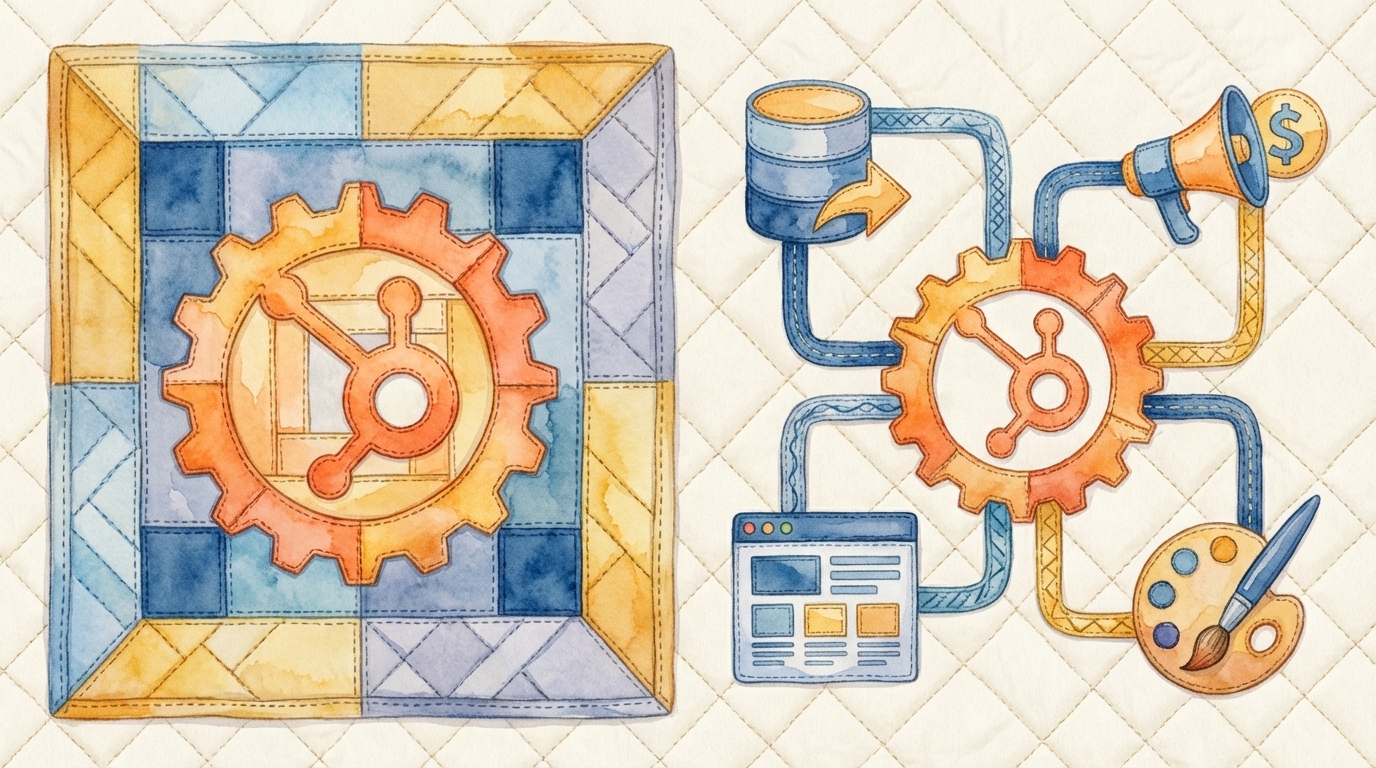
The fundamental difference between HubSpot Breeze and autonomous marketing agents is architectural. Breeze is embedded AI — intelligence built into a specific platform that enhances workflows within that platform. Autonomous agents are cross-platform AI — intelligence that operates across your full marketing stack, connecting to and operating inside multiple tools simultaneously.
Think of it this way: Breeze is like having an AI assistant who works inside your HubSpot office. They are excellent at everything that happens in that office. But when the campaign requires work in the LinkedIn Ads office, the Google Ads office, the Salesforce office, or the WordPress office, the Breeze assistant stays behind. You have to walk to those offices yourself and do the work manually.
Autonomous agents are platform-agnostic. They connect to HubSpot, Marketo, Salesforce, LinkedIn Ads, Google Ads, your CMS, and the rest of your stack. When a campaign requires work across multiple platforms — which virtually all campaigns do — the agent moves between tools, configuring and deploying in each one. The campaign ends up live across your full stack, not just inside HubSpot.
The cross-platform test: For your most recent campaign, list every tool that was involved in making it live. If HubSpot is the only tool on the list, Breeze may be sufficient. If the list includes three or more tools — which is typical for any multi-channel campaign — you need AI that operates across all of them. Platform-embedded AI solves one piece. Autonomous agents solve the whole puzzle.
When Breeze Is Enough
Breeze is the right choice for marketing teams that have consolidated their stack onto HubSpot. If you use HubSpot CRM, Marketing Hub, CMS Hub, and Sales Hub — and you run your ads through HubSpot's ad management — Breeze gives you AI across the full workflow. This is most common in SMB environments and early-stage companies that started with HubSpot and have not yet added specialist tools for specific channels.
Breeze is also the right choice for HubSpot-specific workflows within a larger stack. If you use HubSpot for email marketing but WordPress for your website and Salesforce as your CRM, Breeze still makes your HubSpot email workflows better. It just does not touch the WordPress or Salesforce parts of the campaign.
For teams in this situation, Breeze is a no-brainer upgrade — it is included with HubSpot, requires no additional integration work, and starts delivering value immediately within HubSpot's boundaries.
When You Need Autonomous Agents
You need autonomous agents when your campaigns span multiple platforms and the deployment bottleneck is not inside any single tool — it is across the seams between tools. Specifically:
- Multi-platform campaigns: When a single campaign requires emails in HubSpot, landing pages in WordPress, ads in LinkedIn and Google, and CRM updates in Salesforce
- Cross-tool workflows: When the campaign logic spans platforms — a form submission in HubSpot triggers a Salesforce task, which triggers a sales deck personalization in Google Slides
- High-volume deployment: When you need to launch 20+ campaigns per month and the bottleneck is build-and-deploy capacity across your full stack
- Platform migration: When you are moving between MAPs and need campaigns deployed consistently across both during the transition
In these scenarios, Breeze handles the HubSpot portion of the workflow, but the deployment work in every other tool remains manual. Autonomous agents operate across the full stack, eliminating the manual deployment step regardless of which tools are involved.
The Complementary Model
For many teams, the right answer is not Breeze or autonomous agents — it is both. Breeze enhances the day-to-day HubSpot workflow with AI suggestions, content generation, and predictive analytics. Autonomous agents handle the cross-platform campaign deployment that Breeze cannot reach. The two approaches are complementary, not competitive.
Teams based in San Francisco and across the country are increasingly adopting this model: use HubSpot Breeze for in-platform productivity, and use autonomous agents for end-to-end campaign deployment across the full stack. The result is AI coverage across the entire marketing operation, not just the HubSpot portion.
Choosing Based on Your Stack, Not the Hype
The right choice depends entirely on your stack architecture and your deployment bottleneck. If your stack is HubSpot-centric and your bottleneck is content creation within HubSpot, Breeze is sufficient and cost-effective. If your stack spans multiple platforms and your bottleneck is cross-platform campaign deployment, you need agents that operate everywhere your campaigns live.
HubSpot Breeze makes HubSpot smarter. Autonomous agents make your entire marketing stack faster. If your campaigns span more tools than just HubSpot — and most do — see how CharacterQuilt's agents deploy across your full stack, getting campaigns live in hours instead of weeks.