
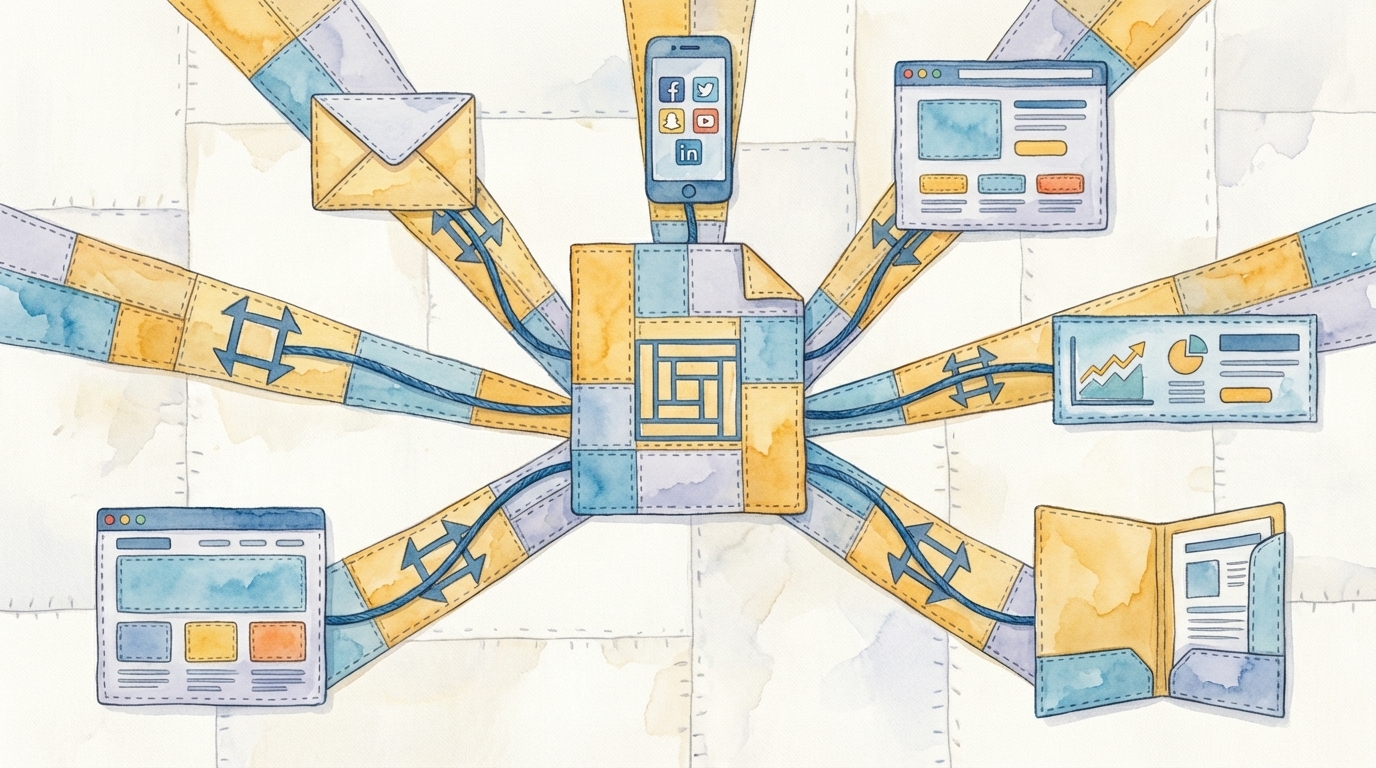
Running a multi-channel campaign in 2026 means logging into your email platform, your ad manager, your CMS, your CRM, your design tool, and probably a project management tool to keep track of it all. Each platform has its own workflow, its own templates, and its own constraints. The result is campaigns that feel stitched together rather than orchestrated — because they are. Multi-channel campaign orchestration should not require you to be a human integration layer across ten different tools.
The promise of multi-channel marketing has always been compelling: surround your target accounts with consistent messaging across every touchpoint. The reality has been far less elegant. Most teams spend more time coordinating across tools than they spend on strategy or creative. That coordination tax is the silent killer of campaign velocity.
The Pain of Coordinating Across Platforms
Let us walk through what a typical multi-channel campaign looks like today. Your demand gen team wants to launch an integrated campaign targeting mid-market fintech companies. Here is the actual workflow:
- A strategist writes a campaign brief in a Google Doc.
- A copywriter drafts email sequences, ad copy, and landing page copy — often in three separate documents.
- A designer creates email templates in one tool, ad creatives in another, and landing page designs in a third.
- Someone builds the emails in the email platform, manually copying in the approved copy and uploading the designed assets.
- Someone else creates the ad campaigns in Meta, Google, and LinkedIn, each with its own interface and requirements.
- A developer or marketing ops person builds the landing pages in the CMS, wiring up forms and tracking.
- Someone configures the CRM to track responses and route leads appropriately.
- A project manager chases all of these people to make sure everything launches on the same day with consistent messaging.
That is eight steps involving at least five people and six or more tools. The surface area for errors is enormous. A headline gets updated in the email but not on the landing page. The ad creative uses a different value proposition than the email. The CTA on the landing page does not match what the ad promised. These inconsistencies erode trust with your prospects and dilute your campaign impact.
"A campaign is not truly multi-channel if the channels are not saying the same thing. Consistency across touchpoints is not a nice-to-have — it is the entire point of orchestration."
What "One Brief" Orchestration Looks Like
Imagine a different workflow. You write a single campaign brief that specifies your target audience, the campaign objective, your key message, your proof points, and the channels you want to activate. From that one brief, the entire campaign is generated and deployed.
This is not a hypothetical. Teams are already operating this way, and the results are transformative. The brief serves as the single source of truth, and every asset generated from it inherits the same messaging, visual identity, and strategic intent.
The brief includes:
- Target audience. Who are you reaching? Which accounts, which segments, which personas?
- Campaign objective. Awareness, consideration, or conversion? This determines the messaging tone and CTA strategy across all channels.
- Core message. The single most important thing you want the audience to understand or do.
- Proof points. Case studies, statistics, or testimonials that support your core message.
- Channels. Email, LinkedIn ads, Google display, landing pages, sales enablement materials — whatever the campaign requires.
- Brand parameters. Your visual identity, tone of voice, and any campaign-specific creative direction.
From this input, the system produces every asset the campaign needs, adapted for each channel's unique format and requirements. To see this in practice, explore our how it works page.
Asset Generation Across All Channels
The power of single-brief orchestration is that each channel gets purpose-built assets that are still connected by shared DNA. Here is what gets generated from a single brief:
Email sequences. A three-to-five email nurture sequence with subject lines, preview text, body copy, and CTAs — all reflecting the campaign's core message and adapted for the target segment. Each email builds on the previous one rather than repeating the same pitch.
Ad creative. Display ads in standard IAB sizes, LinkedIn sponsored content, and Meta ad variations. Each format gets creative optimized for its platform — a LinkedIn ad uses professional language and a clear business outcome, while a display ad prioritizes visual impact and brand recognition.
Landing pages. A campaign landing page (or multiple, if you are personalizing by segment) with messaging that directly continues the conversation started by the ad or email that drove the visit. The headline on the landing page echoes the ad copy. The proof points match what the email promised.
Sales enablement. One-pagers and follow-up templates that your sales team can use when campaign-generated leads come in. These materials maintain the same messaging framework so the handoff from marketing to sales feels seamless to the prospect.
Teams in San Francisco and around the world are using this approach to launch campaigns that used to take three weeks in three days.
Deployment Into Each Tool
Generating the assets is only half the battle. The other half is getting them into the platforms where they will be activated. This is where most "AI content generation" solutions stop — they give you a document or a design file, and you still have to manually upload, configure, and deploy across every platform.
True orchestration means the assets deploy directly into your marketing stack:
- Emails publish into your email platform with the correct templates, segments, and send schedules already configured.
- Ads push into your ad accounts with the correct targeting, budgets, and creative variations ready to launch.
- Landing pages publish into your CMS with forms, tracking pixels, and UTM parameters in place.
- CRM workflows are configured to route leads, update account scores, and trigger sales notifications.
This direct deployment eliminates the manual data entry that introduces errors and burns hours of your team's time. It also means campaigns can launch faster because you are not waiting for someone to log into six different platforms and copy-paste assets into each one.
Consistent Messaging Across Touchpoints
The deepest benefit of single-brief orchestration is not speed — it is coherence. When a prospect sees your LinkedIn ad, clicks through to a landing page, receives a follow-up email, and then gets a call from a sales rep, every touchpoint tells the same story.
This matters more than most teams realize. B2B buyers interact with an average of seven or more touchpoints before converting. If those touchpoints are sending conflicting messages, the buyer's confidence erodes. If they are reinforcing the same core narrative with increasing depth and specificity, the buyer's conviction grows.
Consistent messaging across touchpoints means:
- The ad promise matches the landing page headline
- The email value proposition aligns with the ad creative
- The sales follow-up references the same proof points the prospect already encountered
- The case study on the landing page is the same one the sales rep discusses on the call
This is nearly impossible to achieve manually at scale. When each channel is produced by a different person using a different tool at a different time, drift is inevitable. When every channel is generated from a single brief, coherence is automatic.
For more on how campaign fragmentation hurts performance, read our post on the problem with a ten-tool marketing stack.
One Brief, One Campaign, Every Channel
You should not need to be an expert in six platforms to launch a coordinated campaign. You should not need a project manager to make sure the email and the ad say the same thing. And you certainly should not be spending more time on logistics than on strategy. Multi-channel campaign orchestration from a single brief is not just a time-saver — it is a fundamentally better way to run campaigns. Stop stitching and start orchestrating. Your prospects will notice the difference, and so will your pipeline.