
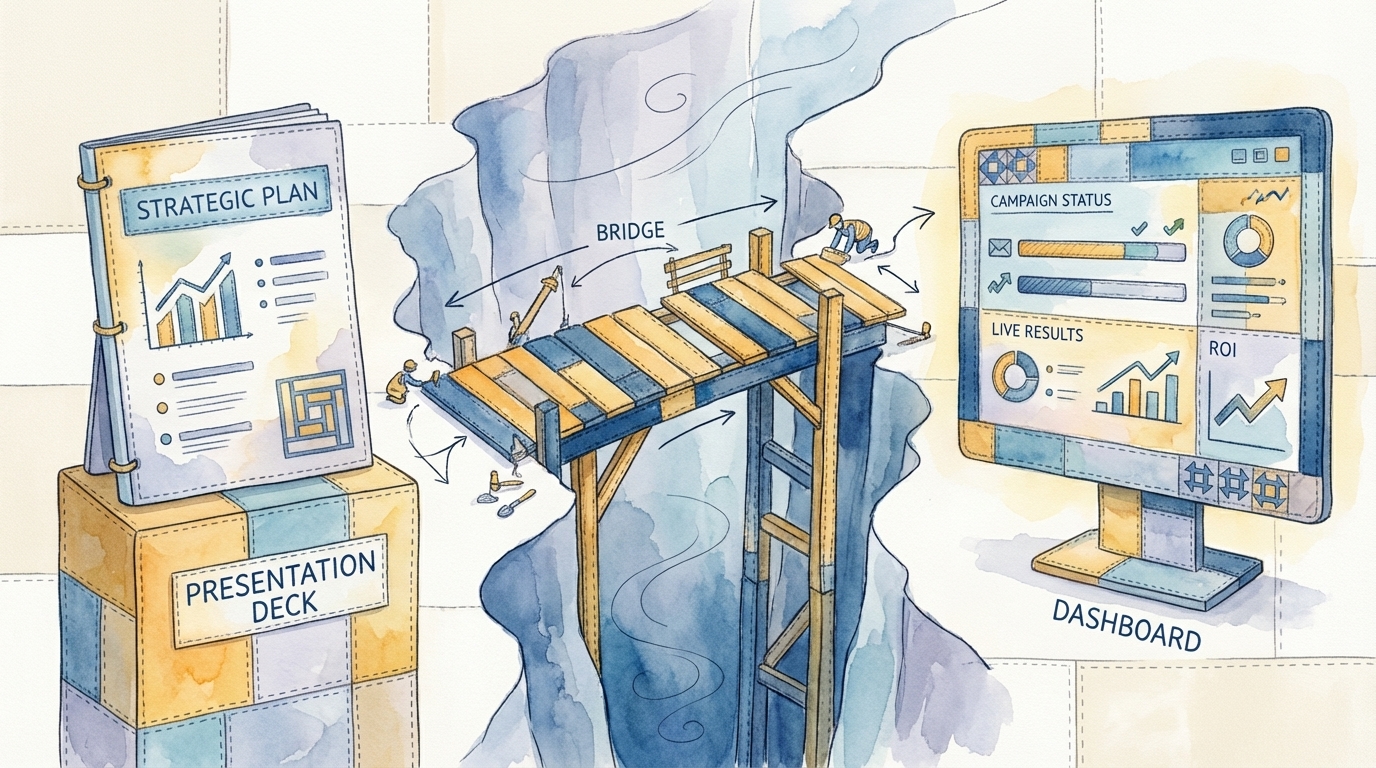
When a marketing vendor says they will "deploy" a campaign, ask them exactly what that means. In most cases, it means they will hand you a strategy deck, a set of copy documents, and maybe some design files. They call it deployed. You call it more work for your team.
The gap between a campaign recommendation and a live campaign is where most marketing vendors fall short. And it is the gap that costs you the most — in time, in pipeline, and in the compounding opportunity cost of campaigns that sit in production limbo instead of generating results.
The Delivery Spectrum: Decks, Assets, and Actual Deployment
Not all marketing deliverables are created equal. There is a spectrum of what vendors and tools actually produce, and understanding where each falls on that spectrum saves you from expensive misalignment.
Level 1: Strategy and Recommendations
Consultancies and strategy-focused agencies operate here. They deliver campaign briefs, audience analyses, messaging frameworks, and channel recommendations. The output is a deck — sometimes a very good deck — that tells your team what to do. But it does not do anything itself. Your team still needs to translate those recommendations into built campaigns inside your platforms.
Level 2: Asset Generation
Point tools and creative agencies operate here. They produce the individual assets a campaign needs — email copy, landing page designs, ad creatives, maybe even some marketing automation templates. The output is closer to a finished campaign, but it is still a collection of files that someone on your team needs to assemble, configure, and deploy inside your tools.
Level 3: End-to-End Deployment
This is where "deployed" actually means deployed. The emails are built and live inside your Marketo, HubSpot, or Responsys instance. The workflows are configured with the right triggers, delays, and branching logic. The landing pages are published on your domain with working forms, tracking, and thank-you page redirects. The ad campaigns are created in LinkedIn and Google with targeting, budgets, and conversion pixels in place.
A campaign is not deployed when the deck is delivered. A campaign is deployed when a prospect can see the ad, click through to the landing page, fill out the form, enter the nurture sequence, and show up in the sales team's CRM — all without your team touching a single platform.
Most marketing teams operate with vendors and tools at Level 1 or Level 2, which means they are still responsible for the most time-consuming and technically demanding part of campaign execution: the build and deploy.
Why the Last Mile Is the Hardest Mile
Building a campaign inside a marketing platform is not glamorous work, but it is where the detail and the complexity live. Consider what "building an email in HubSpot" actually involves:
- Creating the email with the correct template and module structure
- Entering the copy with the right formatting, links, and personalization tokens
- Configuring the sender name, reply-to address, and subject line (plus A/B variant)
- Setting up the associated workflow with enrollment triggers, delays, and goal criteria
- Connecting the workflow to the right list or segment
- Adding the UTM parameters and tracking for attribution
- Testing across email clients to ensure rendering is correct
- QA-ing every link, token, and merge field
That is one email in one campaign. A typical multi-touch campaign might have four to six emails, a landing page, a form, a thank-you page, a nurture workflow, and ad campaigns across two or three platforms. The total last-mile work for a single campaign is often 15 to 25 hours of hands-on platform time.
Deployment is not a checkbox — it is a process. Getting a campaign from "approved brief" to "live and tracking" requires dozens of individual configuration steps across multiple platforms, each of which needs to be done correctly for the campaign to function.
This is the work that agencies skip, that point tools cannot do, and that your internal team is perpetually behind on. It is not strategic work. It is not creative work. It is technical execution work — and it is the bottleneck that determines how many campaigns you can actually run.
What Real Deployment Looks Like
When we say CharacterQuilt deploys campaigns, here is what we mean — concretely and without ambiguity:
Emails built in your platform. Not copy in a Google Doc. Fully constructed emails inside your marketing automation instance, with personalization, formatting, and testing complete.
Workflows configured. Enrollment triggers, delays, if/then branching, lead scoring updates, and CRM sync — all set up and ready to activate. Not a flowchart in a slide. The actual workflow in your platform.
Landing pages published. Live on your domain, with the form connected to your MAP, the confirmation logic in place, and the tracking pixels firing. Not a Figma mockup. A working page that prospects can visit and convert on.
Ads created in the platform. LinkedIn Sponsored Content, Google Search, display retargeting — built inside the ad platforms with targeting, creative, budgets, and conversion tracking configured. Not a media plan spreadsheet. Live campaigns.
Reporting connected. Campaign dashboards or reports set up so your team can track performance from the moment the campaign goes live. Not a "we will set up reporting in Phase 2" caveat.
This is the standard for what "deployed" should mean. If your current vendors or tools are not delivering at this level, you are absorbing the most expensive part of campaign execution internally. Our How It Works page walks through the mechanics of how AI agents achieve this across platforms.
The Cost of Partial Deployment
When campaigns stop at Level 1 or Level 2, the downstream effects are significant:
- Slower time to market. Every campaign spends extra days or weeks in your team's build queue, waiting for the technical execution to happen.
- Reduced campaign volume. Your throughput is capped by your team's ability to build and deploy, regardless of how many strategies or assets you have ready.
- Quality inconsistencies. When your team is rushed to deploy, mistakes happen — broken links, wrong personalization tokens, missing tracking, misconfigured workflows.
- Strategic talent doing tactical work. Your most experienced marketers end up spending their time on platform configuration instead of the strategic and creative work that drives outsized results.
Teams across the Bay Area and nationally are recognizing that the deployment gap is the single biggest constraint on their marketing performance — not budget, not strategy, not tools. For a look at specific scenarios where end-to-end deployment changes the equation, explore our Use Cases page.
Raising the Bar for Your Vendors
The next time a vendor, agency, or tool promises campaign execution, ask these questions:
- Will the campaign be built inside my marketing automation platform, or will I receive files to build myself?
- Will the workflows be configured and ready to activate, or will my ops team need to set them up?
- Will the landing pages be published on my domain, or will I receive designs to implement?
- Will the ad campaigns be created in my ad platforms, or will I receive a media plan to execute?
If the answer to any of those is "you will receive files/recommendations to implement," then you are not getting deployment. You are getting deliverables. And the most expensive part of the work is still on your plate.
Ready to see what end-to-end deployment actually looks like for your team and your stack? Book a demo and we will show you how CharacterQuilt takes campaigns from brief to live — inside the platforms you already use, without adding work to your team's queue.