

Account-based marketing has become the consensus go-to-market strategy in B2B. According to Demandbase's 2024 State of ABM report, more than 70% of B2B companies now operate some form of ABM program. Terminus data corroborates this, showing ABM adoption nearly doubling between 2020 and 2024. The logic is sound: ITSMA research consistently demonstrates that ABM programs deliver 208% higher revenue compared to non-ABM approaches. Every B2B executive has seen the data. Every marketing leader has the slide deck. And yet, the vast majority of these programs personalize for no more than 10 to 25 accounts — an operational ceiling that makes ABM a pilot program, not a growth engine.
This research report examines why that ceiling exists, what it would take to personalize campaigns for 100 accounts simultaneously, and how AI agent architectures are making that threshold operationally feasible for the first time. The findings draw on published ABM benchmarks, martech platform data, and anonymized patterns from enterprise marketing teams running agent-driven ABM programs out of San Francisco and nationally.
The ABM Promise vs. Reality
The ABM promise is elegant: instead of casting a wide net and hoping the right accounts engage, you identify your highest-value targets and build marketing programs specifically for them. Every touchpoint is relevant. Every message resonates. Every dollar is spent on accounts that actually fit your ICP. In theory, this produces higher conversion rates, shorter sales cycles, and larger deal sizes. In practice, it produces a pilot with five to ten accounts, a Salesforce dashboard showing promising early signals, and a backlog of 90 accounts that will "get personalized next quarter."
ABM is a massive problem space. The reality is that almost nobody is executing it at scale yet — the strategy is clear, but the operational machinery does not exist at most companies.
The gap between ABM strategy and ABM execution is not a knowledge problem. Marketing leaders understand what good ABM looks like. They have read the Forrester reports. They have attended the Demandbase roadshow. The gap is purely operational: the work required to personalize campaigns for 100 accounts exceeds the capacity of any reasonably-sized marketing team using manual or semi-automated workflows.
Consider the basic math. A mature ABM program for a single account involves a personalized landing page, a tailored email sequence (typically three to five emails), two to three ad creative variants, a custom sales one-pager, and a personalized outbound sequence. That is roughly six to ten unique assets per account. For 100 accounts, you are producing 600 to 1,000 personalized assets — each requiring research, writing, design, QA, and deployment into the correct platform. No marketing team of four to eight people can sustain that output while also running the rest of their demand generation program.
Why ABM Breaks at Scale: The 10-Account Ceiling
The operational ceiling is not arbitrary. It emerges from three compounding constraints that intensify as account count increases.
Constraint 1: Research and Enrichment
Meaningful personalization requires meaningful research. For each target account, the marketing team needs firmographic data (industry, size, revenue, growth stage), technographic data (what tools they use, what integrations matter), intent signals (what topics they are actively researching), competitive context (who else is selling to them), and organizational mapping (who the decision-makers are and what they care about). Clay's waterfall enrichment approach has improved data coverage from roughly 40% to 78% email find rates by layering multiple data providers. But enrichment is not just data retrieval — it is synthesis. Someone has to turn raw data into actionable personalization inputs. At 10 accounts, a senior marketer can do this manually. At 100, it becomes a full-time research function.
Constraint 2: Content Production
Each account needs content that reflects its specific context. A healthcare company gets messaging about HIPAA compliance and patient engagement. A fintech company gets messaging about regulatory frameworks and transaction velocity. A manufacturing company gets messaging about supply chain visibility and operational efficiency. Writing distinct, credible content for each vertical and each account within that vertical is skilled work that scales linearly with account count. Most ABM programs hit the content wall at 15 to 20 accounts.
Constraint 3: Multi-Tool Deployment
The average enterprise marketing stack includes 12 or more martech tools, according to Chiefmartec's marketing technology survey. An ABM campaign for a single account typically touches five or more of those tools: a CRM (Salesforce, HubSpot), a marketing automation platform (Marketo, Pardot), a CMS (WordPress, Webflow), an ad platform (LinkedIn Campaign Manager, Google Ads), and an ABM platform (Demandbase, 6sense, Terminus). Each tool has its own configuration requirements, its own interface, and its own deployment workflow. Multiplying that across 100 accounts creates a combinatorial explosion that even sophisticated marketing ops teams cannot manage manually.
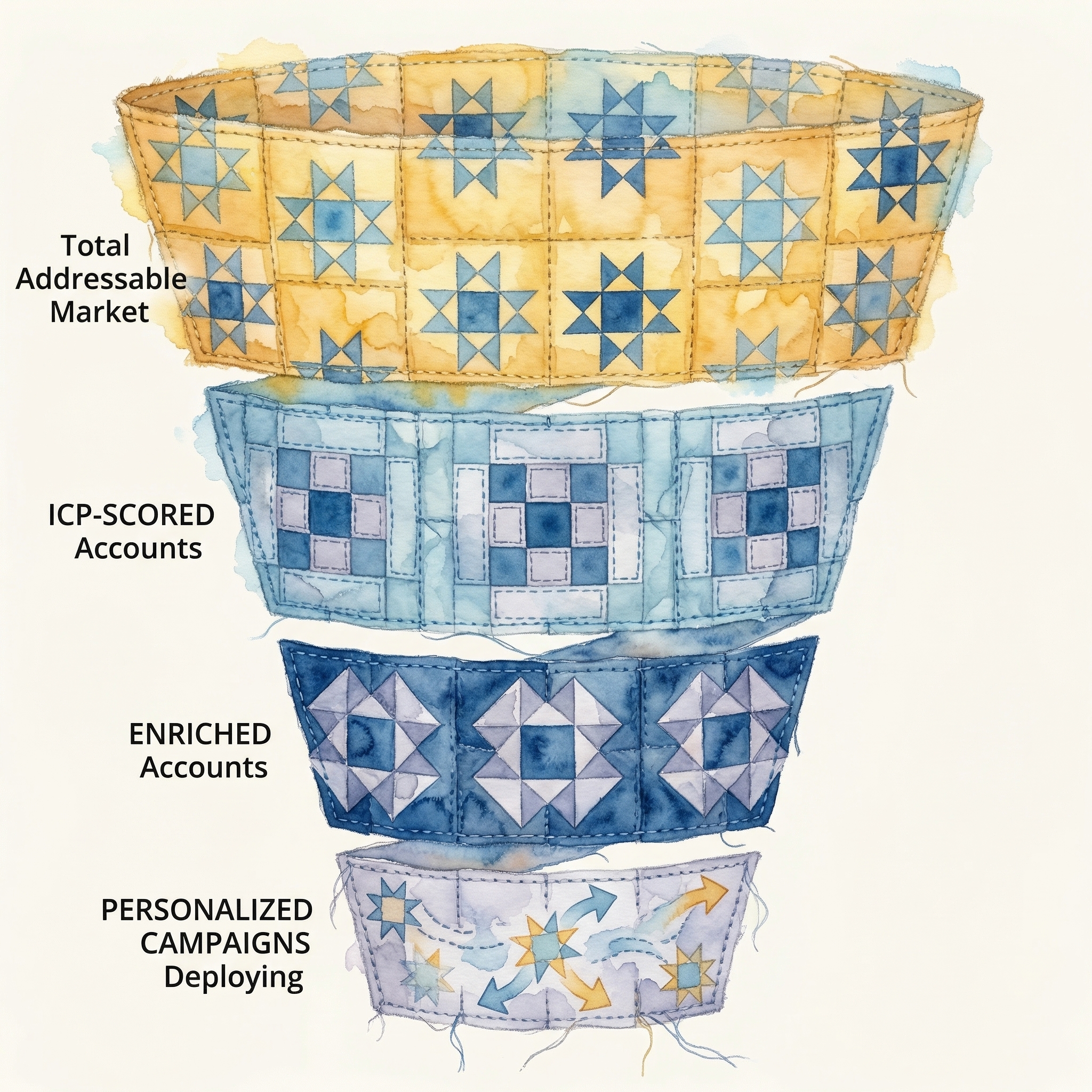
The 10-account ceiling in numbers: At 10 accounts, an ABM program requires approximately 60 to 100 unique assets deployed across 5+ tools — manageable for a dedicated team. At 100 accounts, that number reaches 600 to 1,000 assets, each requiring coordination across the same tool stack. The workload does not scale linearly — it compounds, because cross-tool dependencies create exponential configuration overhead.
What 100-Account Personalization Actually Requires
To move past the ceiling, it helps to be precise about what 100-account ABM demands. Based on benchmarks from ABM programs that have achieved this scale, here is the operational scope:
- Account research packets: 100 enrichment profiles synthesizing firmographic, technographic, intent, and competitive data into personalization briefs.
- Personalized landing pages: 100 unique pages, each with account-specific messaging, relevant case studies, industry-appropriate visuals, and dynamic CTAs. Studies consistently show personalized landing pages convert 2 to 5 times better than generic alternatives.
- Tailored email sequences: 300 to 500 emails across 100 accounts (three to five per sequence), each reflecting the account's specific pain points and buying context.
- Ad creative variants: 200 to 300 display and social ad creatives tailored by account cluster or individual account, deployed with account-matched targeting parameters.
- Sales enablement materials: 100 custom one-pagers or battle cards that arm your sales team with account-specific talking points and competitive positioning.
- Deployment and activation: Every asset configured, QA'd, and live inside the correct platform — CRM workflows updated, email sequences activated, landing pages published, ad campaigns launched with correct budgets and targeting.
The total asset count approaches 800 to 1,000. The total platform touchpoints number in the thousands. And this is not a one-time effort — ABM programs require ongoing optimization as engagement data comes in, meaning the maintenance burden scales with the initial deployment. This is why, as we covered in ABM Without the Army, most teams stall well before reaching this threshold.
The Personalization Matrix: Verticals x Asset Types
One of the structural challenges of scaled ABM is that personalization is not one-dimensional. You are not just personalizing by account name — you are personalizing across a matrix of verticals, company sizes, buying stages, and asset types. A useful framework is the Personalization Matrix, which maps target verticals against required asset types to reveal the total content surface area.
For a company targeting five industry verticals (say, healthcare, financial services, manufacturing, technology, and retail) across the standard ABM asset set (landing pages, email sequences, ad creatives, sales materials), the matrix produces 20 unique content combinations at the vertical level alone. Layer in account-specific customization within each vertical — where each of 100 accounts gets further personalization based on their specific company context — and the matrix expands to hundreds of unique content nodes.
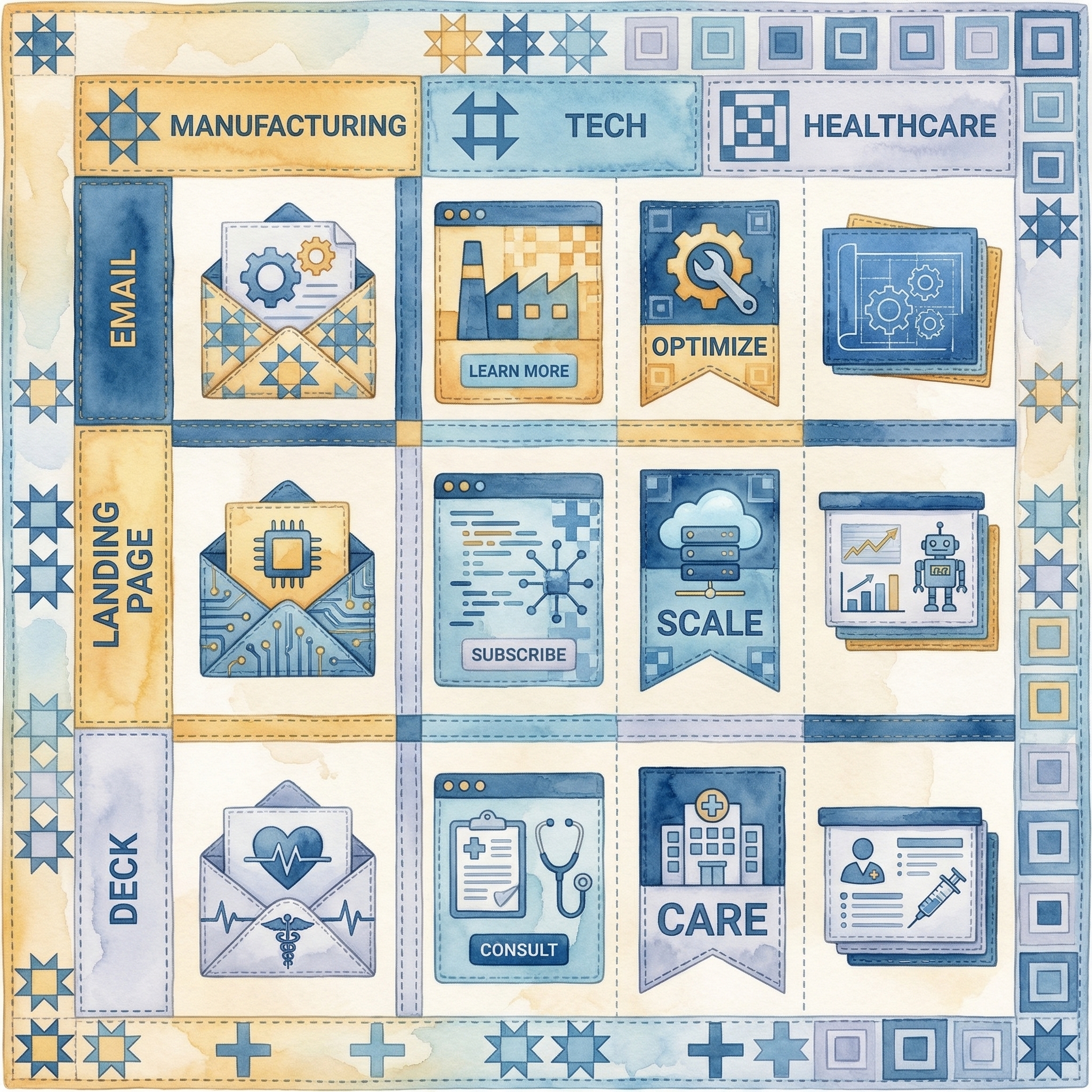
The Personalization Matrix is what separates genuine ABM from cosmetic personalization. Swapping a company name into a template is cosmetic. Building content that reflects the intersection of a specific vertical's pain points, a specific company's context, and a specific asset type's format requirements — that is genuine personalization. And it is genuine personalization that produces the 208% revenue lift ITSMA documented.
The practical implication: any solution to the 100-account problem must be able to traverse this matrix efficiently, producing content that is meaningfully differentiated at each node while maintaining brand consistency across the entire program.
The Agent-Driven ABM Pipeline
AI agents offer a fundamentally different approach to ABM execution because they can operate across the full pipeline — from enrichment through creative production through deployment — without the handoffs that create bottlenecks in manual workflows. The agent-driven ABM pipeline has three phases:
Phase 1: Enrichment and Synthesis
Agents pull data from multiple enrichment providers using waterfall logic (similar to Clay's approach, where if one provider lacks data, the next is queried automatically). But agents go beyond data retrieval. They synthesize enrichment data into structured personalization briefs — identifying the key pain points, relevant case studies, competitive dynamics, and messaging angles for each account. This transforms raw data into creative inputs. What used to take a researcher two to three hours per account takes an agent minutes, with the output structured for immediate use by downstream creative agents.
Phase 2: Content Generation and Creative Production
Using the personalization briefs as input, creative agents generate the full asset set for each account. Landing page copy and layout. Email sequence messaging and subject lines. Ad copy and headline variants. Sales one-pager content. Each asset is generated within brand guidelines — the visual identity, tone of voice, and messaging framework defined by the marketing team. The key distinction from generic AI content tools is that these agents operate with full context: they know the account's industry, the specific pain points identified in enrichment, the relevant case studies from the company's library, and the brand standards that govern every asset.
Phase 3: Platform Deployment
The third phase is where most AI marketing tools stop — and where the operational bottleneck actually lives. Generating personalized content is valuable only if that content gets deployed into the platforms where it reaches the target account. Deployment agents handle the last mile: publishing landing pages to the CMS, configuring email workflows in the marketing automation platform, setting up ad campaigns with correct targeting and budgets, and updating CRM records with campaign associations. This is the work that typically requires a marketing ops specialist spending 30 to 60 minutes per account per platform. At 100 accounts across five platforms, that is 250 to 500 hours of ops work — eliminated.
The bottleneck in ABM has never been strategy or even content. It has been the operational work of getting personalized assets built, configured, and deployed across a fragmented tool stack. Agents collapse that pipeline from weeks to hours.
Deployment Coverage: Getting Assets Into Every Channel
Deployment coverage — the percentage of planned assets that actually make it into production across all intended channels — is the metric that separates ABM programs that deliver results from those that look good in planning documents. In manual ABM programs, deployment coverage degrades as account count increases. Teams prioritize the top 10 accounts, partially cover the next 15, and leave the remaining 75 with generic or no personalization at all.
Agent-driven pipelines maintain consistent deployment coverage regardless of account count because the marginal cost of deploying to the 100th account is the same as deploying to the first. Every account in the program gets the full asset set, deployed across all intended channels, with proper tracking and attribution configured. This is the operational shift that moves ABM from "strategic pilot" to "scalable growth engine." You can explore the full range of deployment scenarios on our Use Cases page.

The primary ABM platforms — Demandbase, 6sense, and Terminus — excel at account identification, intent data, and targeting. But they focus on the targeting layer, not the execution layer. They tell you which accounts to go after and when those accounts are showing intent. They do not build your landing pages, write your email sequences, design your ad creatives, or deploy your campaigns. The execution gap between "this account is showing intent" and "this account has a fully personalized campaign live across all channels" is where most ABM programs lose their advantage. Agent-driven pipelines close that gap.
Case Pattern: From ICP List to 100 Deployed Campaigns
The following is an anonymized composite based on patterns observed across enterprise marketing teams running agent-driven ABM programs. It is representative, not a single case study.
Starting point: A B2B SaaS company with an ICP list of 200 target accounts, segmented across four industry verticals. The marketing team consisted of six people: a director, two demand gen managers, a content marketer, a designer, and a marketing ops specialist. Their existing ABM program covered 12 accounts with full personalization. They estimated it would take nine months and two additional hires to expand to 50 accounts using their current workflows.
Agent deployment: The team adopted an agent-driven pipeline that handled enrichment, content generation, and multi-platform deployment. Over a four-week ramp period, they deployed personalized campaigns for 100 accounts — each receiving a personalized landing page, a three-email nurture sequence, two LinkedIn ad variants, and a custom sales one-pager. Total unique assets deployed: 700.
Results at 90 days: Personalized landing pages converted at 3.4 times the rate of the company's generic product pages. Email reply rates for personalized sequences were 2.8 times higher than their standard nurture. Pipeline generated from the 100-account program exceeded the pipeline from their previous 12-account program by 340%. The marketing ops specialist, previously spending 80% of their time on campaign configuration, shifted to performance analysis and program optimization.
The capacity shift: The team's prior approach required approximately 20 hours of total work per account across research, content, design, and deployment. The agent-driven pipeline reduced that to roughly 2 hours per account — almost entirely spent on review and approval rather than production. That is a 10x capacity gain without adding headcount.
The Economic Argument
The cost comparison between traditional ABM execution and agent-driven ABM execution is stark. Here are the three primary models:
Agency model: Outsourcing ABM execution to a specialized agency typically costs $3,000 to $8,000 per account per quarter for full-service personalization (research, content, design, deployment). At 100 accounts, that is $300,000 to $800,000 per quarter — a budget only the largest enterprises can justify. Turnaround time is typically four to eight weeks per account batch, and quality degrades as the agency scales because they face the same manual constraints as internal teams.
Internal team model: Building an internal ABM execution team capable of supporting 100 accounts requires an estimated four to six additional full-time roles (researchers, content writers, designers, ops specialists) at a loaded cost of $400,000 to $750,000 per year. Hiring takes three to six months. Ramp time adds another two to three months. The total cost-to-production timeline is six to nine months, and the team's capacity is still capped by human throughput limits.
Agent-driven model: An agent-driven pipeline reduces the per-account cost to a fraction of the agency model — typically $200 to $600 per account per quarter depending on asset complexity and deployment scope. At 100 accounts, total quarterly cost ranges from $20,000 to $60,000. Deployment time from ICP list to live campaigns is measured in days, not months. And the marginal cost curve flattens as account count increases, because agents handle the incremental volume without proportional cost increase.
The economic gap is not marginal. Agent-driven ABM execution costs 80 to 90% less than the agency model and 70 to 85% less than building an equivalent internal team — while delivering faster time-to-market and more consistent deployment coverage.
Getting Started: The 10 to 25 to 100 Account Ramp
For teams considering agent-driven ABM, the path to 100 accounts is not a single leap. The most successful programs follow a staged ramp that builds confidence and refines the pipeline at each stage.
Stage 1: 10 Accounts (Weeks 1-2)
Start with your highest-priority accounts — the ones your sales team is already working. Use agent-driven enrichment and content generation to produce personalized assets, but have your team manually review every asset before deployment. This stage is about calibrating quality standards and establishing the feedback loop between human reviewers and agent output. Fix the messaging frameworks, adjust the brand guidelines, and document what "good" looks like for each asset type.
Stage 2: 25 Accounts (Weeks 3-4)
Expand to your next tier of target accounts, including accounts across multiple verticals. At this stage, shift from reviewing every asset to reviewing a sample (roughly 30 to 40%) and spot-checking the rest. The pipeline should be producing assets that require minimal edits. Deploy across all intended channels and begin measuring engagement metrics against your existing baselines. This is where you validate the conversion lifts from personalization.
Stage 3: 100 Accounts (Weeks 5-8)
Scale to the full program. Review cadence shifts to exception-based: the team reviews flagged assets and samples from each batch, but does not manually approve every asset. Deployment is fully automated across all platforms. Performance dashboards track engagement by account, vertical, and asset type. The team's role evolves from production to program management — optimizing targeting, refining messaging, and making strategic adjustments based on results.
The 10-25-100 ramp typically completes in six to eight weeks. By comparison, building the same program manually takes six to nine months. That time advantage is not just about efficiency — it is about competitive positioning. The first company to run personalized ABM campaigns against a target account has a structural advantage over the second.
ABM at scale is no longer a resource allocation problem. It is a pipeline architecture problem. The companies that solve it first — by building agent-driven execution pipelines that convert account data into deployed campaigns — will capture a disproportionate share of their target accounts' attention, pipeline, and revenue. The 10-account ceiling is not a law of physics. It is an artifact of manual workflows that agents have made obsolete.