
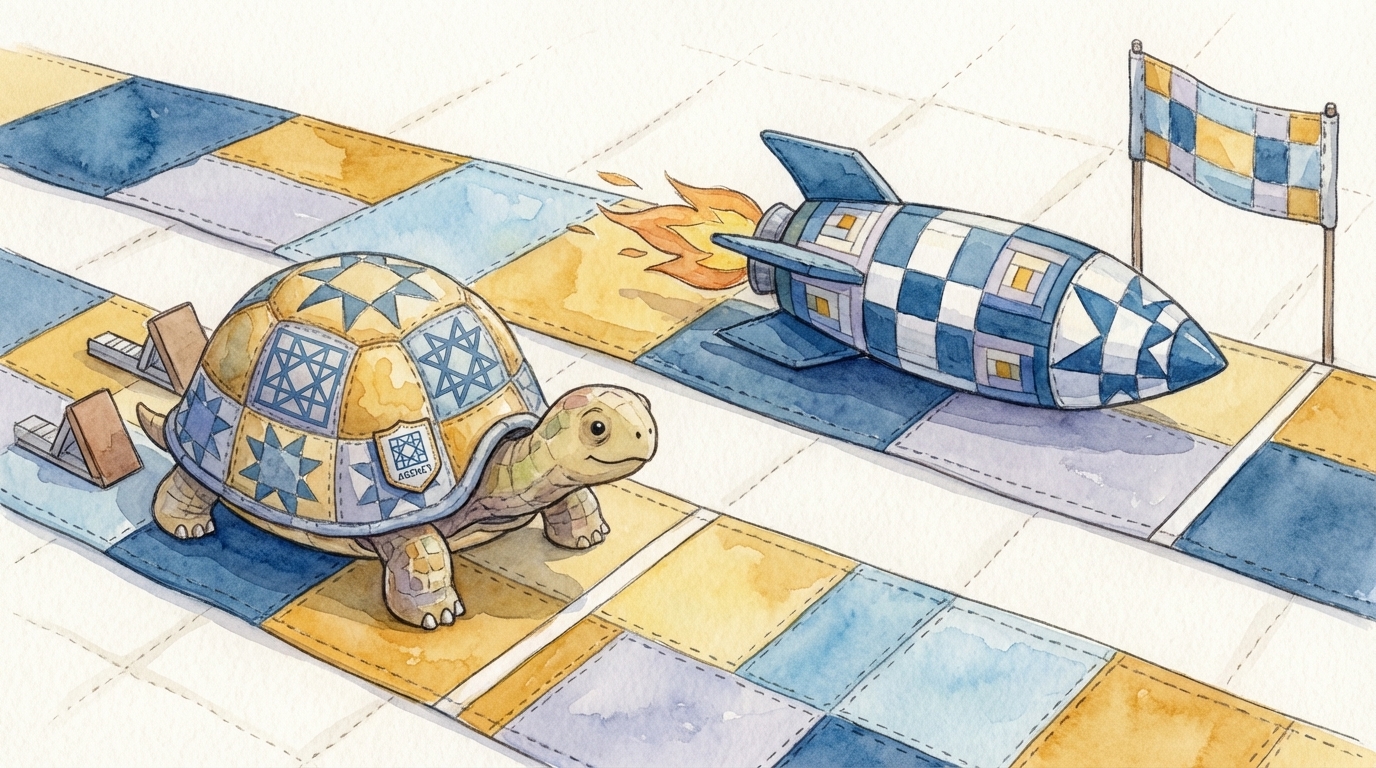
The traditional marketing agency model has a speed problem, and it is structural — not a quality issue, not a talent issue, not a management issue. Agencies employ smart, skilled people who produce excellent work. The problem is that the agency delivery model is built on a sequence of human handoffs, each of which introduces scheduling delays, communication overhead, and approval queues. The average agency campaign delivery timeline is 6-8 weeks from brief to live campaign. That is not because agencies are slow. It is because humans coordinating with other humans through meetings, email chains, and revision cycles is inherently slow. Autonomous marketing agents compress everything except the human review step to near-zero — and that changes the math entirely.
This is not an argument that agencies are bad or that the people at agencies are not talented. Many agencies produce work that is strategically sharper and creatively stronger than what any AI can produce today. The argument is about the structural limitations of a model that routes every task through a chain of human specialists, and what happens when the non-creative parts of that chain can be automated.
The 6-Week Agency Timeline, Deconstructed
Here is what a typical agency campaign timeline looks like, broken into its component phases. These timelines are averages based on industry surveys and reflect mid-market agencies working with B2B clients:
Weeks 1-2: Briefing and Strategy
The client submits a brief. The account team reviews it, schedules a kickoff meeting, and translates the brief into an internal creative brief. The strategy team develops targeting recommendations, channel mix, and messaging framework. There are usually one to two rounds of strategic alignment between the client and the agency before creative begins. Elapsed time: 8-12 business days, mostly driven by meeting scheduling and internal review cycles.
Weeks 3-4: Creative Development
Designers create visual concepts. Copywriters produce messaging. The creative director reviews and refines. The account team packages everything for client presentation. The client reviews, provides feedback, and the agency iterates. For a multi-channel campaign, this includes email designs, landing page mockups, ad creative, and possibly sales enablement materials. Elapsed time: 8-10 business days, driven by creative production and client review scheduling.
Week 5: Revisions and Approvals
Client feedback from the creative review triggers a revision cycle. Some assets need minor tweaks; others need significant rework. Legal or compliance review may add additional time. The agency produces revised assets, and the client does a final approval pass. Elapsed time: 4-6 business days, driven by revision scope and approval queue depth.
Week 6: Build and Deployment
Approved creative is handed to the agency's production team or the client's marketing operations team for implementation. Emails are built in the MAP, landing pages are coded, ads are uploaded and configured, workflows are set up, and QA is performed. This step often takes longer than planned because production resources are shared across multiple clients. Elapsed time: 5-8 business days.
Total: 25-36 business days, or roughly 6-8 calendar weeks. For large enterprises with more complex approval processes, add two to three more weeks.
The irony of the agency model is that the actual production work — writing, designing, building, deploying — might total 40-60 hours of labor. But those hours are spread across six weeks because they are distributed across multiple people with competing priorities, connected by meetings, email threads, and approval queues. The work is fast. The coordination is slow.
The Agent Timeline: Same Campaign, Different Model
Now consider the same campaign executed by autonomous marketing agents. The workflow looks fundamentally different because it eliminates the coordination overhead:
- Brief submitted: 15 minutes (client fills out a structured brief)
- Data enrichment and audience research: 10-15 minutes (agents pull firmographic data, intent signals, and competitive context)
- Creative generation: 15-30 minutes (agents produce email copy, landing page content, ad creative, all on-brand)
- Human review and approval: 1-4 hours (this is the human step — a marketer reviews, edits, and approves)
- Campaign deployment: 15-30 minutes (agents build everything inside the client's marketing tools — MAP, CMS, ad platforms)
Total: 2-6 hours, with the vast majority of that time being the human review step. Everything that is not human judgment compresses to near-zero.
The bottleneck shifts from coordination to judgment. In the agency model, most elapsed time is coordination — scheduling, communicating, waiting in queues. In the agent model, the only time-consuming step is the one that should be time-consuming: a human reviewing the work and applying judgment. Everything else is automated. This is not about replacing human judgment. It is about eliminating the operational overhead that surrounds it.
Why Agencies Cannot Match Agent Speed (Even With Great People)
Agency speed is not limited by talent. It is limited by the physics of human coordination. Every handoff between people — from strategist to creative director, from designer to copywriter, from account manager to client, from production team to QA — introduces a scheduling delay. People have meetings. People work on multiple accounts. People take lunch breaks. People go home at night. None of these are problems with people. They are properties of people. And they set a floor on how fast any human-coordinated process can move.
Agents do not have meetings. Agents do not context-switch between clients. Agents do not wait for other agents to be available. When one step finishes, the next step starts immediately. The only pause in the workflow is when a human needs to review something, and even that is structured to minimize friction — the agent presents the work in a review-ready format, the human approves or requests changes, and the agent implements changes instantly.
Some agencies have tried to speed up by adopting agile processes, reducing revision rounds, or using AI tools for content generation. These help at the margins. But they cannot overcome the fundamental coordination constraint. As long as the workflow routes through a chain of human specialists, the timeline is governed by scheduling and communication, not production capacity. A San Francisco-based team building autonomous agents understood this structural issue and designed a model that eliminates coordination overhead entirely.
When You Still Need an Agency
Agents are not the right answer for every marketing need. Agencies bring strategic thinking, creative vision, market insight, and brand stewardship that AI cannot replicate today. If you need a complete brand overhaul, a messaging architecture for a new market entry, or creative work that pushes boundaries, a great agency is worth every day of that 6-week timeline. The strategic and creative thinking is the value.
But for the 80% of marketing campaigns that are executional — the nurture programs, the product launches, the event promotions, the ABM plays, the content syndication campaigns — the agency model is paying for human coordination overhead on work that does not require it. These campaigns follow known patterns, use established brand guidelines, and need to be deployed quickly and consistently. They are the campaigns that pile up in the backlog while the team waits for agency deliverables.
The Hybrid Model: Agencies for Strategy, Agents for Execution
The most effective model is not agencies or agents. It is agencies for high-value strategic and creative work, and agents for high-volume executional campaigns. The agency handles the brand strategy, the big creative concepts, and the campaigns that require genuine creative innovation. Agents handle the volume — deploying the fifty email campaigns, twenty landing pages, and thirty ad sets that the strategy calls for, at a fraction of the cost and a fraction of the time.
Your agency is not slow because they lack talent. They are slow because human coordination has a speed limit. Autonomous agents operate without coordination overhead, compressing campaign delivery from weeks to hours. If your backlog is full of campaigns waiting to be built and deployed, the answer is not a faster agency — it is a different model entirely.