
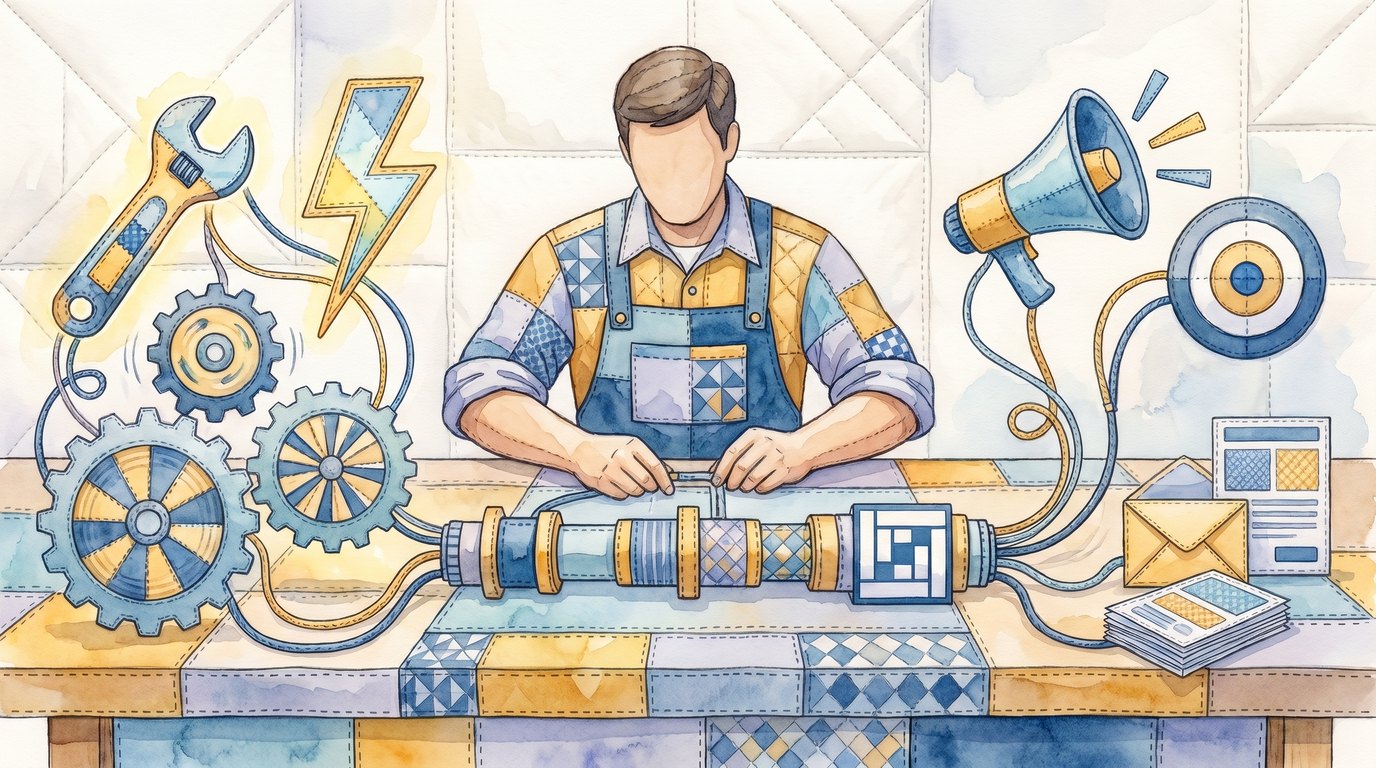
For the last decade, marketing teams have been told to buy more tools. A tool for email. A tool for ads. A tool for enrichment. A tool for webinars. A tool for attribution. A tool for landing pages. A tool for personalization. A tool for sales enablement. A tool for reporting. A tool for intent. A tool for orchestration.
The result is not leverage. The result is a modern marketing team where the most important campaigns still get stuck in the same place: deployment.
The brief is written. The audience is known. The message is approved. The creative direction is clear. The sales team is waiting. The market moment is live. And then the campaign disappears into the operational swamp.
Someone needs to build the Marketo program. Someone needs to QA the nurture logic. Someone needs to upload the LinkedIn audiences. Someone needs to convert the design into an email that does not break. Someone needs to clone the landing page. Someone needs to make sure the Salesforce campaign is connected. Someone needs to wire up reporting. Someone needs to rebuild the same thing across five systems that were never designed to work together.
This is the real bottleneck in modern marketing. Not strategy. Not creativity. Not ideas. Execution — and more specifically, technically constrained execution across an increasingly fragmented stack.
That is why we believe the next great marketing role is not the go-to-market engineer. It is the forward deployed marketer.
What a forward deployed marketer is
The term "forward deployed" is most associated with Palantir: technical people working directly with customers, deeply embedded in real operational problems, and responsible for translating messy real-world workflows into working systems. Marketing needs its version of that.
But the forward deployed marketer is not a marketer learning to code. That distinction is the whole argument.
Most go-to-market engineer roles are framed as commercially minded operators picking up technical skills: learning automation tools, writing a few scripts, stitching together workflows, becoming more systems-oriented. That is useful. It is also not enough.
The forward deployed marketer is the inverse. It is an engineer learning marketing. Someone who can sit inside the messy reality of a marketing organization, understand the campaign goal, understand the systems constraint, understand the brand, understand the revenue motion — and then actually make the machine work. Not just advise. Not just strategize. Not just write copy. Not just create tickets. Build, integrate, automate, deploy, QA, and improve the operating system of marketing itself.
The marketer of the future does not need to become a mediocre engineer. The engineer of the future needs to become fluent in marketing.
The tools are powerful. They are also raw.
Here is the part the go-to-market engineer framing gets backwards. The new generation of AI tools — Codex, Claude Code, agentic coding environments — are not gentle, guardrailed apps with a tidy UI. They are raw power. They will write a thousand lines of working code, refactor a system, call an API, and deploy — and they will do all of that exactly as instructed, including the parts you did not think through.
Raw power is not the same as ease. A table saw cuts faster than a hand saw, but it does not make a non-carpenter a carpenter. It makes a carpenter dramatically more productive and makes everyone else dangerous. The skill that matters is not "can you turn it on." It is knowing what to build, how to decompose it, where it breaks, what to verify, and when to stop.
That skill is engineering. It is the instinct to see a one-off task and ask what the abstraction is — what is the input, what is the output, what is deterministic, what needs judgment, what should be a template, what should be an agent, what breaks in production, what has to be monitored. A marketer who learns to prompt an AI tool can generate output. An engineer who learns marketing can build the system that makes the output safe, repeatable, and correct.
Give raw tools to someone without that instinct and you do not get leverage — you get a faster way to produce broken Marketo programs. The bottleneck does not move. It just generates more work downstream. We wrote about the deeper version of this in why AI agents can write code but can't deploy your campaign: the hard part was never generation. It was everything that has to be true for generated work to go live.
The asymmetry that matters: Teaching an engineer the marketing context — buyer psychology, brand voice, the revenue motion, why a campaign matters commercially — is a learnable, bounded problem. Teaching a marketer to wield raw, unguardrailed AI tooling safely is teaching them an entire discipline. The forward deployed marketer is built on the easier of the two transfers.
Why marketing now needs engineers, not just operators
Marketing has quietly become one of the most technical functions in the company. A modern campaign is no longer a piece of content. It is a distributed system. It includes CRM objects, audience logic, enrichment rules, creative assets, email templates, landing pages, ad platforms, forms, webinar systems, attribution rules, lead scoring, routing logic, reporting dashboards, approval workflows, compliance constraints, brand guidelines, and personalization variants.
Every campaign is effectively software. But most marketing organizations are not staffed like software teams. They are staffed like content teams, demand generation teams, and operations teams. Those teams are talented, but they are often forced to ship through a stack that behaves more like brittle infrastructure than a clean creative workflow.
That is why campaigns take weeks. Not because marketers are slow — because marketing execution now requires systems thinking, integration work, data modeling, workflow design, QA discipline, and the ability to debug weird edge cases across tools that were never meant to talk to each other. Buying an eleventh tool does not fix that; as we argued in your marketing stack has 10 tools, you don't need an 11th, more point solutions create more work, not less.
This is not marketing ops with a new name
Marketing operations is one of the most underappreciated functions in the company. But in many organizations, marketing ops has become a service desk for the rest of marketing. Can you build this email? Can you upload this list? Can you fix this workflow? Can you clone this webinar program? Can you pull this report? Can you make sure this syncs to Salesforce?
That model does not scale. Marketing ops becomes the human API between strategy and execution. Every campaign has to pass through them. Every urgent launch becomes a queue. Every idea becomes a dependency.
The forward deployed marketer is different. They are not just operating the stack — they are rebuilding the way the stack gets operated. They ask: What should be automated? What should be templatized? What should be generated by agents? What needs human review? Where does brand judgment matter? Where does deployment fail? Where are we relying on humans to do work that should be infrastructure?
The job is not to become faster at clicking buttons. The job is to remove the button-clicking layer entirely.
AI makes this role more important, not less
There is a popular idea that AI will make marketing easier because everyone can generate more content. That is only partially true. AI makes it easier to create drafts, generate variants, brainstorm campaigns, and personalize messaging. But that creates a second-order problem.
If every team can generate 100 campaign ideas, 100 email variants, 100 landing page drafts, and 100 audience segments, the bottleneck simply moves downstream. Who decides what is on-brand? Who turns the work into approved assets? Who deploys it into Marketo, HubSpot, LinkedIn, Salesforce, Meta, or whatever the customer actually uses? Who keeps it consistent? Who makes sure it does not break? Who closes the loop from campaign performance back into the next campaign?
AI increases the need for deployment infrastructure. It does not eliminate it. The companies that win will not be the ones that generate the most marketing content — they will be the ones that turn intelligence into launched campaigns the fastest.
That is the work of forward deployed marketers. And it is why the constraint has shifted from ideas to throughput.
Engineers are unusually well-suited for this
The best forward deployed marketers do not start by asking "what campaign should we run?" They ask "what system makes this campaign repeatable?" That instinct matters.
An engineer sees a one-off campaign and immediately looks for the abstraction. What is the input? What is the output? What data is required? What decisions are deterministic? What requires human judgment? What should be a template? What should be an agent? What should be an API call? What breaks in production? What has to be monitored?
That is exactly the mindset marketing needs — because the real problem at scaling companies is not a shortage of ideas. It is that every idea has to be manually rebuilt from scratch across an operational maze. An engineer trained in marketing can look at a campaign and see both the customer-facing message and the machinery underneath it. That combination is rare. It is also becoming necessary.
A new kind of full-stack role
A forward deployed marketer is not a brand marketer, not a demand generation manager, not a solutions engineer, and not a traditional marketing ops specialist. They are closer to a full-stack campaign engineer.
They understand positioning, but they also understand APIs. They can think about buyer psychology, but they can also debug a broken sync. They care about brand consistency, but they also care about data models. They know why a campaign matters commercially, but they can also build the workflow that gets it live. They move comfortably between:
- campaign strategy and audience architecture
- creative systems and lifecycle automation
- CRM and marketing-automation implementation
- analytics and attribution
- agent workflows and human approval loops
- customer-specific integrations and the weird realities of a real stack
This is not "technical marketing" in the old sense. It is marketing deployment as an engineering discipline — the same shift we mapped in the agentic marketing stack.
Why CharacterQuilt believes in forward deployed marketers
At CharacterQuilt, we are building AI infrastructure for marketing teams: a brain that learns your brand, workflows that turn agent work into approved campaigns, and agents that operate your existing tools. That means our work does not stop at generating content. Generating content is the easy part.
The hard part is helping marketing teams get from a brief to a launched campaign inside the systems they already use. That requires being close to the customer — close to their stack, their brand, their approval process, the weird realities of their CRM, their templates, their naming conventions, their campaign hierarchy, their sales motion, and their internal politics. You cannot solve that from a generic prompt box. You solve it by deploying engineers into the real marketing workflow and teaching them to understand the marketing problem deeply enough to automate it correctly. That is the essence of the forward deployed marketer.
They are not there to replace the CMO, the creative team, or demand gen. They are there to turn the marketing organization's intent into working infrastructure.
The marketing team is about to look different
The old marketing team was organized around channels: email, paid media, events, content, web, lifecycle, ops. The next marketing team will increasingly be organized around systems: brand intelligence, audience intelligence, campaign generation, approval workflows, deployment agents, performance feedback loops, stack orchestration.
In that world, the highest-leverage people will be the ones who can connect marketing judgment with technical execution. Some will come from marketing and learn more systems thinking. But the most transformative version of the role will come from engineers who learn marketing deeply enough to build the machines that marketers should have had all along. It is the same pattern that played out in software — and, as we argued in why marketing is the next frontier after code, marketing is next.
An engineer close enough to the customer to understand the campaign. A marketer technical enough to change the system. A builder responsible not for another asset, but for the infrastructure that makes every future asset faster, smarter, and easier to deploy.
Marketing does not need another layer of tools. It needs a new deployment layer. And that layer will be built by forward deployed marketers. If your team is spending more time clicking through marketing platform UIs than thinking about strategy, that gap is costing you every week — talk to CharacterQuilt about closing it.