
Sales deck personalization is one of those things every sales leader talks about and almost no sales team actually does well. You know the drill: your company has a master pitch deck. It is polished, brand-approved, and thoroughly generic. Reps are supposed to customize it for each prospect, but most do not — because it takes too long, they do not know what to change, or they are afraid of breaking the design. So the same sixty-slide deck goes out to every account, and buyers can tell.
Enterprise buyers expect you to show up prepared. They expect you to know their company, their industry, their competitive landscape, and their specific challenges. A generic deck signals that you have not done the work — and in competitive deals, that is often the difference between making the shortlist and getting eliminated early.
Why Generic Decks Lose Enterprise Deals
Think about what happens when your rep walks into a meeting with a prospect and opens a deck that says "Helping Companies Transform Their Operations" on the cover slide. The prospect immediately knows this is the same presentation your rep gave to the last ten companies. There is no signal that you understand their world.
Now imagine the same meeting, but the cover slide references the prospect's company by name. The second slide cites a challenge from their most recent earnings call. The case study slide features a company in their exact industry and of similar size. The ROI model uses assumptions based on their publicly available metrics.
That is a different meeting. That is a meeting where the prospect leans forward and pays attention, because you have demonstrated that you did your homework. Every enterprise seller knows this intuitively. The problem has never been awareness — it has been execution.
A personalized sales deck does not just communicate your value proposition — it communicates that you care enough about this specific account to do the work. In enterprise sales, that signal matters as much as the content itself.
What Account-Specific Personalization Actually Means
Personalization is not slapping a logo on the cover slide and calling it done. Meaningful sales deck personalization involves several layers:
- Company research integration — Recent news, earnings data, strategic initiatives, leadership changes, and public statements woven into the narrative
- Industry pain points — Challenges and trends specific to the prospect's vertical, not generic business problems
- Relevant case studies — Examples from companies the prospect would consider peers, not random logos from your customer base
- Custom slides — ROI models with prospect-specific assumptions, competitive positioning against their current vendors, implementation timelines based on their infrastructure
- Stakeholder-specific versions — A version for the technical evaluator that goes deep on architecture, a version for the CFO that focuses on business outcomes
Doing all of this manually for a single account takes a rep or a sales enablement specialist two to four hours. For a team managing fifty active opportunities, that is a hundred to two hundred hours per cycle — just on deck customization. Most teams do not have that bandwidth, so they compromise. And every compromise reduces win rates.
The personalization paradox: The accounts that benefit most from personalized decks — large enterprise deals with long sales cycles and multiple stakeholders — are also the ones where reps have the least time to spare. They are juggling discovery calls, stakeholder mapping, procurement navigation, and internal selling. Deck personalization falls to the bottom of the list even though it has outsized impact on deal outcomes.
AI-Generated Variations at Scale
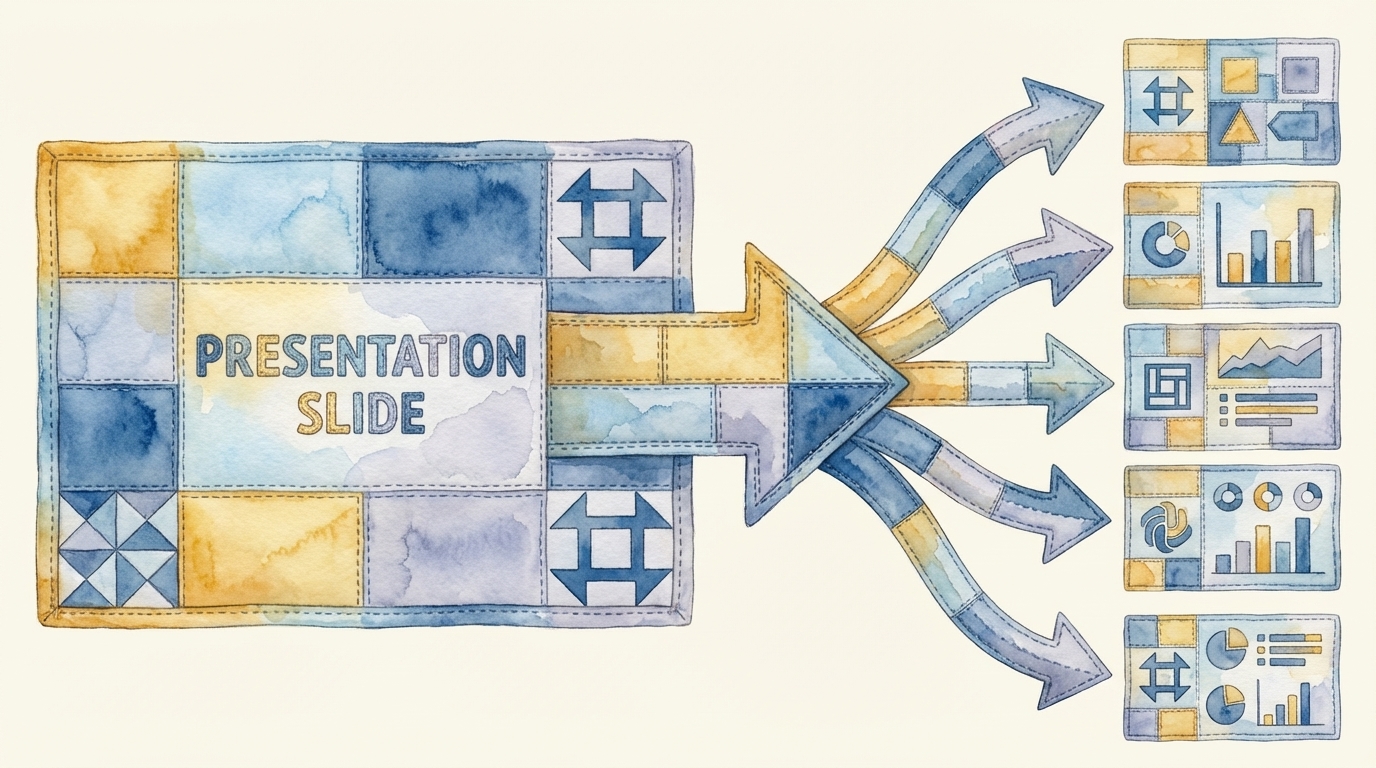
The breakthrough is that AI agents can now do the research, generate the customizations, and produce finished account-specific decks — without requiring a human to spend hours on each one. Here is how it works in practice.
You start with your master deck — the brand-approved, design-polished version that represents your best thinking on positioning and narrative. The AI agent takes this as the foundation and, for each target account, pulls in relevant company data, selects appropriate case studies, generates custom slides, and produces a complete personalized version.
The rep reviews the output, makes any adjustments based on their relationship knowledge, and walks into the meeting with a deck that looks like it took hours to prepare. Some of the most effective sales teams we have seen, from San Francisco startups to established enterprise vendors, have adopted exactly this workflow. To explore how this fits into a broader sales enablement strategy, check out our use cases.
Maintaining Brand and Design Standards
One of the biggest concerns sales enablement leaders have about decentralized deck customization is brand consistency. When every rep is editing the master deck on their own, you end up with a hundred versions — each with slightly different fonts, misaligned logos, off-brand colors, and inconsistent messaging. The brand team cringes, and prospects get a disjointed experience.
AI-generated personalization solves this by working within the design system rather than outside it. The master deck's layout, typography, color palette, and design elements are locked. Personalization happens within those constraints — the right content gets placed in the right templates, maintaining visual consistency across every version.
This gives the brand team confidence that every deck going out to prospects meets their standards, while giving sales the account-specific content they need to win. It is the rare case where both sides get what they want.
From One Deck to a Hundred: The Operational Model
Here is what the operational model looks like for a team that has adopted AI-powered deck personalization:
- Quarterly: The product marketing and sales enablement team updates the master deck with new positioning, case studies, and competitive intelligence
- Weekly: AI agents generate or refresh account-specific versions for active opportunities, pulling in the latest company research and relevant proof points
- Per meeting: Reps request a stakeholder-specific version for an upcoming call — a technical deep-dive for the CTO, an ROI-focused version for the CFO — and receive it within hours instead of days
The result is a sales team that shows up to every meeting with a deck that feels custom-built for that prospect — because it is. And the sales enablement team spends their time on strategy and messaging, not on manually building slides. Read more about the kind of enablement content reps actually use in our post on sales enablement that works.
The Impact on Deal Velocity
Personalized decks do not just improve win rates. They accelerate deal velocity. When your materials are tailored to each stakeholder's concerns, meetings become more productive. Objections surface faster because you are addressing real concerns, not generic ones. Internal champions have better ammunition to sell on your behalf — they can share a deck that speaks directly to each colleague's priorities instead of forwarding a generic overview.
The combined effect of higher win rates and faster deal cycles compounds over time. A ten percent improvement in both metrics can translate to significantly more closed revenue per quarter — without adding a single rep to the team.
Ready to turn your generic pitch deck into account-specific weapons for every deal in your pipeline? Book a demo and see how CharacterQuilt generates personalized sales decks at scale — on-brand, account-specific, and ready for your next meeting.