Sales Enablement That Reps Actually Use: One-Pagers, Battle Cards, and Leave-Behinds
Most sales enablement content goes unused. Here's how to create materials your reps will actually pull out in meetings.

Here is a stat that should make every marketing leader uncomfortable: the vast majority of sales enablement content goes completely unused. Reps ignore it. They build their own decks. They screenshot old emails. They wing it. The problem is not that your reps are lazy — it is that most sales enablement content is not built for how reps actually sell. If you want to create sales enablement materials that your team will actually pull out in meetings, you need to rethink what you are producing and how.
The gap between what marketing creates and what sales needs is one of the most expensive inefficiencies in B2B. Marketing spends weeks on polished PDFs. Sales wants a one-pager they can customize in two minutes before a call. Until you close that gap, your enablement program is a cost center, not a revenue driver.
Why Most Sales Content Goes Unused
The root cause is not quality. Most sales enablement teams produce well-designed, well-written content. The problem is relevance, accessibility, and timeliness.
- Too generic. A one-pager that covers your entire platform is useless when a rep needs to speak to a specific pain point for a specific vertical. Reps need materials that match the conversation they are about to have.
- Too hard to find. Content buried in a shared drive or a content management platform with poor search is effectively invisible. If a rep cannot find it in thirty seconds, they will not use it.
- Too static. A battle card from six months ago with outdated competitor pricing does more harm than good. Reps learn quickly which materials they can trust and which are stale.
- Too polished. This sounds counterintuitive, but overly designed PDFs feel like marketing materials, not sales tools. Reps want something that feels like it was made for their specific deal.
"The best sales enablement content does not look like a brochure. It looks like something a smart colleague put together specifically for this deal, this prospect, this conversation."
What Reps Actually Need
Talk to your top-performing reps. Watch what they actually use in meetings. You will find that a small set of content types drives the vast majority of deal influence:
Account-specific one-pagers. A single page that summarizes your value proposition for a specific company or vertical. It includes the prospect's industry context, relevant pain points, a brief solution overview, and one or two proof points. Reps use these as leave-behinds after meetings and as attachments in follow-up emails.
Battle cards. Competitive intelligence formatted for quick reference. What does the competitor claim? Where do they fall short? What questions should the rep ask to expose those gaps? Battle cards need to be current, scannable, and honest — reps will not use them if they feel like spin.
Personalized slide decks. Not your forty-slide corporate pitch deck. A tight five-to-eight slide deck customized for the specific account, with their logo, their industry challenges, and a relevant case study. You can read more about scaling this in our post on sales deck personalization at scale.
Meeting follow-up summaries. After a call, reps need to send a concise recap that reinforces key points and moves the deal forward. A templated follow-up that can be customized in sixty seconds is gold.
Generating Account-Specific Materials at Scale
The reason most enablement content is generic is that making it specific is expensive. Customizing a one-pager for each target account used to mean hours of work per account. Multiply that by fifty accounts and you have a full-time job that produces mediocre results.
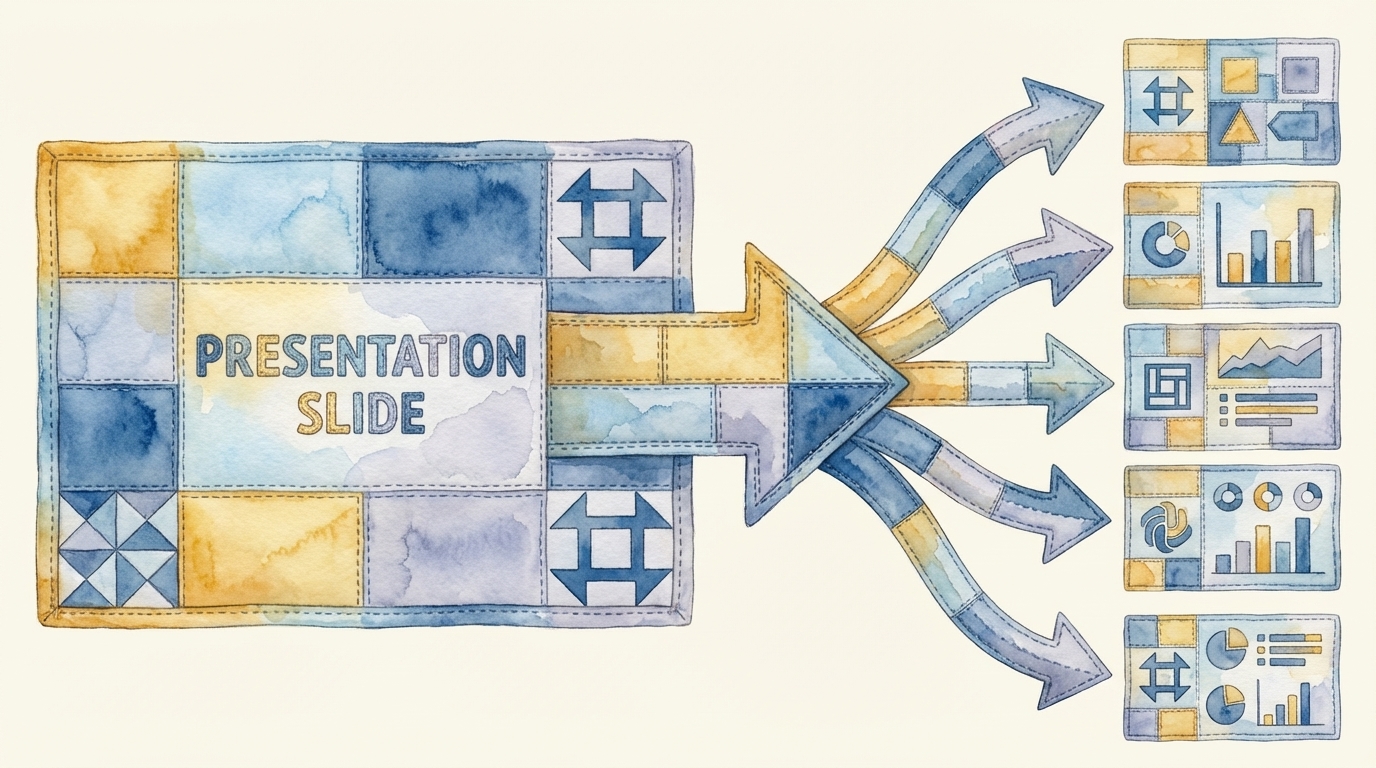
AI agents change this equation dramatically. By combining data enrichment with your brand guidelines and messaging framework, you can generate account-specific materials in minutes instead of hours. The process looks like this:
- Feed in the account. The agent pulls firmographic data, recent news, tech stack information, and competitive context for the target company.
- Apply your framework. Your messaging pillars, value propositions, and proof points are mapped to the account's specific situation.
- Generate the asset. A one-pager, battle card, or slide deck is produced using your brand templates and design system.
- Deliver to the rep. The finished material appears where the rep already works — in their CRM, their inbox, or their sales engagement platform.
Teams working out of San Francisco and across the country are already using this approach to arm reps with fresh, relevant materials before every significant meeting.
Keeping Everything On-Brand
When you scale content production, brand consistency becomes a real concern. If every rep is generating their own materials, you end up with a patchwork of off-brand assets floating around the market.
The solution is to encode your brand guidelines into the generation process itself. Your fonts, colors, logo usage rules, tone of voice, and approved messaging are baked into the system. Every asset that comes out is on-brand by default, not by accident.
This is actually an improvement over the status quo. Right now, your reps are building their own slides in whatever template they can find. They are copying and pasting from old decks with outdated branding. Giving them a tool that produces on-brand materials instantly is better for brand consistency than the current free-for-all.
The Feedback Loop That Matters
The most successful enablement programs build a feedback loop between what is produced and what actually gets used. Track which materials reps open, share, and send to prospects. Track which assets are associated with deals that move forward.
This data tells you what to produce more of and what to stop wasting time on. If your battle cards get opened before every competitive deal but your ROI calculators sit untouched, that is a signal. Double down on what works.
Here is what to measure:
- Asset usage rate (what percentage of produced materials get used at least once)
- Time from creation to first use
- Correlation between asset usage and deal outcomes
- Rep satisfaction scores on enablement materials
- Time reps spend customizing versus creating from scratch
Building an Enablement Engine, Not a Content Library
The old model of sales enablement was a library: produce content, organize it, hope people find it. The new model is an engine: understand what each rep needs for each deal and deliver it proactively.
This shift requires moving from batch production to on-demand generation. Instead of creating a library of generic assets and hoping they cover every scenario, you create a system that produces the exact asset needed for the exact situation at the exact moment the rep needs it.
Check out our use cases to see how teams are building this kind of on-demand enablement engine. The difference between a content library and a content engine is the difference between enablement that exists and enablement that works.
Get Your Reps What They Need
Your sales team does not need more content. They need better content, delivered faster, tailored to their specific deals. Stop producing generic assets that no one uses and start building an enablement engine that arms every rep with account-specific materials before every important conversation. The technology to do this at scale exists today — the only question is how quickly you can put it to work for your team.
Ready to clear your campaign backlog?
Tell us the campaign you have in mind. We'll build it and launch it in the tools you already use.